

A conversation on ‘Communicating Evidence for Sustainable Development’
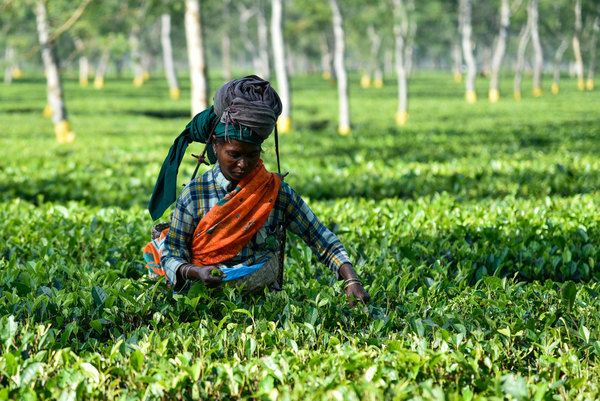
Last month two CABI employees, Solveig Danielsen and Paul Day, attended a conference at Wageningen University on Communicating Evidence for Sustainable Development. Sol works in the Monitoring and Evaluation team (M&E) and Paul is a communicator. The conference led to a lively conversation which we captured here.
Phytosanitary Risk Management Programme – transforming livelihoods in Pakistan

Meet Rozina Babar, she is one of thousands of smallholder farmers in Pakistan whose livelihoods are threatened by agricultural pests and diseases that can devastate crops and ultimately have a severe impact on food security and profitability. However, thanks to the CABI-led Phytosanitary Risk Management Programme – funded by USAID-USDA and working with partners including…
Showcasing smart agriculture in comic exhibition
Comics have long played a role in entertaining young people, and even adults, going right back to the Golden Age of Comic books in the 1930s. One only has to think of Superman, Batman, Wonder Woman, Captain Marvel and many more. But you would be forgiven for being surprised at knowing that comics can also…
Cotton harvest picture special
The power of the image paints a picture that speaks a thousand words and that is certainly the case with these fantastic images taken by photographer Asim Hafeez. Asim was commissioned by CABI to document the process of harvesting cotton in Pakistan – the country’s largest industrial sector – where more than 500,000 farmers…
Termite workshop photo special – exploring tree-damaging termites in the tropics
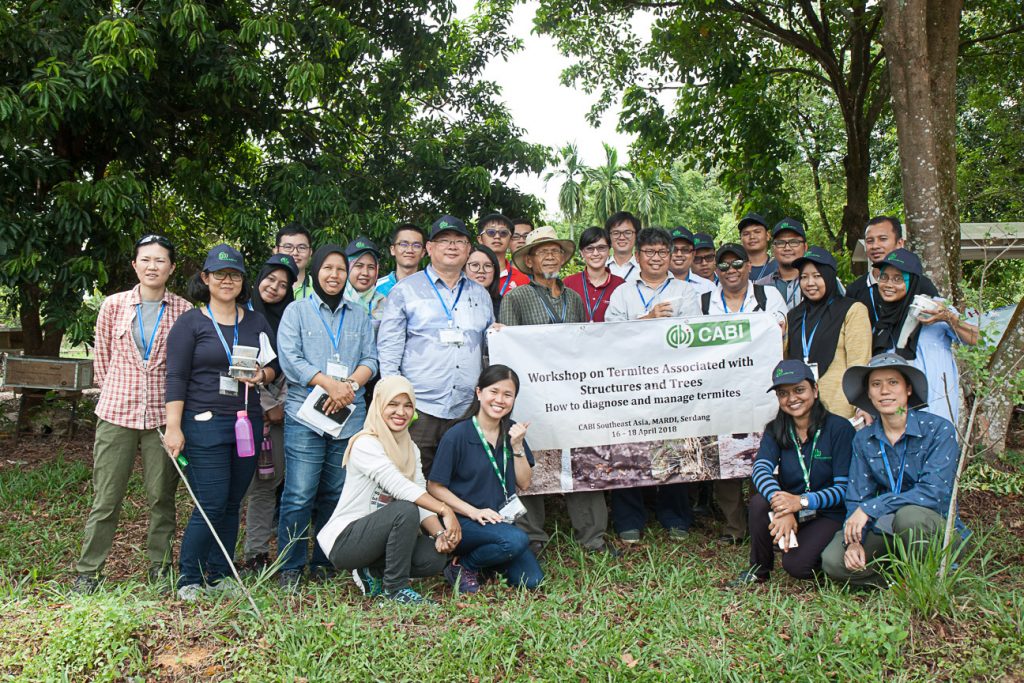
CABI scientists have held a successful three-day workshop exploring how to diagnose and manage termites associated with structures and trees in the tropics. The workshop, held at CABI’s South East Asia (SEA) office building at MARDI in Serdang, Malaysia, highlighted termites as ecologically important insects with significant roles to play as decomposers but also as…
The story of the rare book on plant diseases that returned ‘home’ to China after a 72 year absence
Photo: The 1942 text by Professor Wang Ming-Chih, returned to China after more than 70 years Lesley Ragab thought she knew CABI’s stock of more than 24,000 books and 2,000 journals like the back of her hand after serving as librarian at the organisation’s Egham, UK, office for over 20 years. That was until she stumbled…
Emerging contaminants – a growing concern?
[Image credit: minthu] Over the last 200 years, the global population has been growing at an exponential rate and according to the UN, is predicted to reach 8.5 billion by 2030. The population increase to date, has been supported by the development of agricultural, industrial and health care resources, which has led to the rise…
CABI board member pens Economist blog on US$80bn agricultural investment shortfall
CABI board member Dr Prem Warrior says we must plug a US$80bn global shortfall in agricultural innovation if the world is to be ‘smart’ to the demands of feeding 10 billion people by 2050 and meet the UN’s Sustainable Development Goals. Dr Warrior writes in The Economist Intelligence Unit blog that the challenge is not…
Dr Rob Reeder goes ‘bananas’ about pests and diseases on the Urban Farm Podcast
Plant pathologist Dr Rob Reeder has this week spoken to Greg Peterson of the US-based Urban Farm Podcast about how the global supply of bananas (particularly the Cavendish variety) could be put at risk from a three-pronged attack of pests and diseases. In the podcast, Dr Reeder reveals the reasons why the fungus known as…
How Genetically Modified Organisms (GMOs) Enter the Food Chain in non-GMO Producing Countries
How Genetically Modified Organisms (GMOs) Enter the Food Chain in non-GMO Producing Countries - by Tatjana Brankov A superficial review of the legislation on transgenic foods and feeds indicates that consumers in non-GMO producing countries consume GMO-free food. However, less attention is paid to the fact that GMOs can enter the food chain through the import of transgenic foodstuff and feedstuff or by contamination. In some countries, transgenic food production is fully equal to conventional production. The concept of substantial equivalence, developed by the OECD and further elaborated by FAO/WHO “embodies the concept that if a new food or food component is found to be substantially equivalent to an existing food or food component, it can be treated in the same manner with respect to safety, i.e. the food or food component can be concluded to be as safe as the conventional food or food component” (FAO/WHO 1996). Such a…