
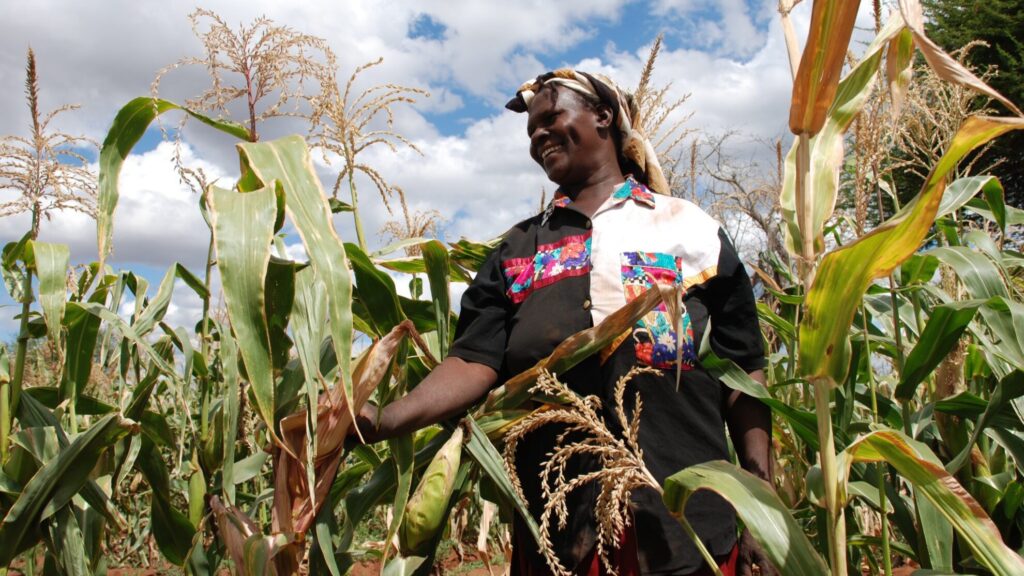
Crop loss can have serious impacts on rural communities. It is frequently measured by reductions in potential yields and economic losses that follow. While these indicators are important, they rarely reveal who within communities and individual households bears the greatest burden.
To address this gap, the Global Burden of Crop Loss (GBCL) recently published a study on maize crop losses in Kenya. The report, Gendered Experiences of Crop Loss in Maize Farming, collected and analysed data by age and gender. Researchers interviewed people from 455 maize-growing households and held discussions and focus groups with stakeholders. The study’s aim was to examine crop loss, looking at its economic, institutional, nutritional, and social dimensions. It focused on four counties in Kenya: Bungoma, Makueni, Nakuru, and Trans Nzoia.
The results showed that when crops are damaged, the loss is not experienced equally in communities and households. Instead, it reinforces existing inequalities and creates new vulnerabilities, especially for women and young people.
Looking beyond crop loss statistics
Maize is more than just a crop in Kenya. It is a mainstay of food and nutrition security and household income. When maize harvests fail due to drought, floods, pests, and other agricultural shocks, the consequences reach far beyond the farm. They impact whether families can access food and healthcare, and whether their children can go to school. They also impact how households cope with financial hardship and who bears the burden of recovery. Crop losses force households to adopt different coping strategies, and vulnerable groups often bear a greater share of the recovery burden.
GBCL wanted to understand the challenges of crop loss in more detail. To capture the diverse experiences of maize farmers, GBCL explored crop loss across farming communities in different agro-ecological zones of Kenya. Bungoma, Makueni, Nakuru, and Trans Nzoia vary greatly in climate, farming practices, and exposure to production risks. However, together, they provide a broad picture of the challenges facing Kenya’s maize sector.
Across all four counties, farmers reported recurring crop losses associated to climate shocks and variability. More than 86% of the farmers surveyed reported biotic stressors. These are organisms such as insects, pathogens, and weeds that cause crop loss. This high percentage demonstrates the scale of the challenge confronting maize producers.
Food security burden falls heavily on women
One of the key findings was the central role that women play in maintaining household food security during periods of agricultural stress. Women often prefer maize over other crops as it is easier to prepare and store. They also concentrate on what happens after maize is harvested, as pests and poor storage can lead to significant food losses. However, this part of food production is often overlooked in the agri-food chain.
When crop loss occurs, women can be affected the hardest. They frequently absorb the shock through food rationing, informal labour or increased unpaid labour, and reliance on social support networks. This invisible resilience helps households to get through difficult periods but often comes at considerable personal cost. The GBCL study shows how gender dynamics shape the experience of crop loss. In maize-dependent communities, deep-rooted social norms and gender roles often limit women’s access to resources. This increases their vulnerability and amplifies the burden of that loss.
Financial stress fuels social pressures
The GBCL study also highlighted how the economic effects of crop loss extend well beyond agricultural production – they influence the wellbeing of communities and households in general. Reduced harvests weaken household incomes, making it difficult for families to meet basic needs. This may mean they forgo spending on essentials such as healthcare or school fees. Critical investments in the next season’s food production might be delayed or dropped altogether. Furthermore, financial hardship increases tensions within households that lead to a rise in domestic conflict and violence against women. The findings also point to the increased risk of child marriage and other protection concerns that affect young women and girls.
These impacts show that crop loss is not simply an agricultural issue. It also heightens social vulnerability, affecting livelihoods, food security, and community resilience.
Children and young people face difficult choices
Crop loss also creates intergenerational vulnerabilities, affecting children, young women, and young men. Economic hardship can force children out of school and prevent young people from pursuing higher education or vocational training. Many are compelled to take on income-generating activities at an early age. Moreover, young women and girls may face increased domestic responsibilities or early marriage. These disruptions limit future opportunities, reinforce existing inequalities, and perpetuate cycles of poverty and vulnerability across generations.
Furthermore, crop loss often leads to migration among young people. Young women and men leave rural areas in search of employment, but the outcomes are uneven. Women are more likely to enter domestic work and face greater risks of exploitation and disruption to their education. Men tend to move into informal labour markets.
Recovery is slow and uneven
The impacts of crop loss are far from short-lived. One of the most striking findings in the research is the length of time that recovery takes after crop loss. Nearly half of affected households that were surveyed (47%) are still recovering from a previous loss, revealing how limited resilience and inadequate support can prolong vulnerability.
The speed of recovery also differed by gender. A higher share of men reported faster recovery over the first three months (25% of men and 17% of women) as well as from three to six months (22% of men and 13% of women). This finding suggests that men have relatively better access to resources such as finance and insurance or recovery mechanisms. Women often carry greater responsibilities for household welfare while having fewer resources available to support recovery.
Institutional support can help to accelerate recovery. However, farmers consistently identified gaps in support as a major factor limiting their ability to rebuild incomes and livelihoods. The challenges include limited extension services, poor agricultural inputs, and weak links to markets. Although awareness of government programmes was relatively high, access to relevant benefits and compensation remained limited. Crop insurance coverage was particularly low, especially among women farmers.
Why gender-disaggregated evidence matters
Without access to age- and gender-disaggregated data, crop loss can appear to affect farming households uniformly. The GBCL study shows that this is not the case. Women, men, and young farmers of both sexes experience crop loss differently. They adopt different coping strategies and face different barriers. Aggregate statistics therefore risk obscuring the social, economic, and emotional burdens carried by specific groups.
Knowing these differences is essential for designing agricultural policies and programmes that reach people who are most affected. Understanding these patterns can help address the root causes of vulnerability more effectively.
Building durable and inclusive maize systems
The research concludes that the loss of maize crops in Kenya causes systemic shocks. The impacts are far-reaching and affect livelihoods, food security, health, education, and social stability. Women play a central role in sustaining household resilience. Yet, they continue to encounter considerable disadvantages in access to resources, extension support services, and decision-making opportunities.
Meeting these challenges will require integrated and gender-responsive approaches that strengthen extension services. This means expanding access to finance and insurance, improving post-harvest systems, and addressing social protection needs. Equally important is collecting and using gender- and age-disaggregated data to ensure interventions and policies reflect the realities of those most affected.
Climate variability and production shocks will continue to threaten agricultural livelihoods. As this happens, building resilience in Kenya’s maize sector will depend not only on protecting crops, but also on recognizing and resolving the unequal burdens that crop loss places on everyone, especially women and young people.
Further information
Read the report: Gendered Experiences of Crop Loss in Maize Farming
Feature image credit: Anne Wangalachi/CIMMYT
Related news/blogs:
CABI workshop explores gendered impact of maize crop loss in Kenya
How digital innovation and better data can strengthen Africa’s food systems
Equipping decision-makers with evidence to tackle global crop loss
Related News & Blogs
How digital innovation and better data can strengthen Africa’s food systems
A recent CABI webinar explored the Global Burden of Crop Loss initiative and how better data, modelling and digital innovation can strengthen Africa’s food systems. The article highlights early findings on crop losses and their economic impacts, as well as the wider role of digital technologies, data systems and collaboration in supporting more resilient and sustainable agriculture.
20 August 2026