

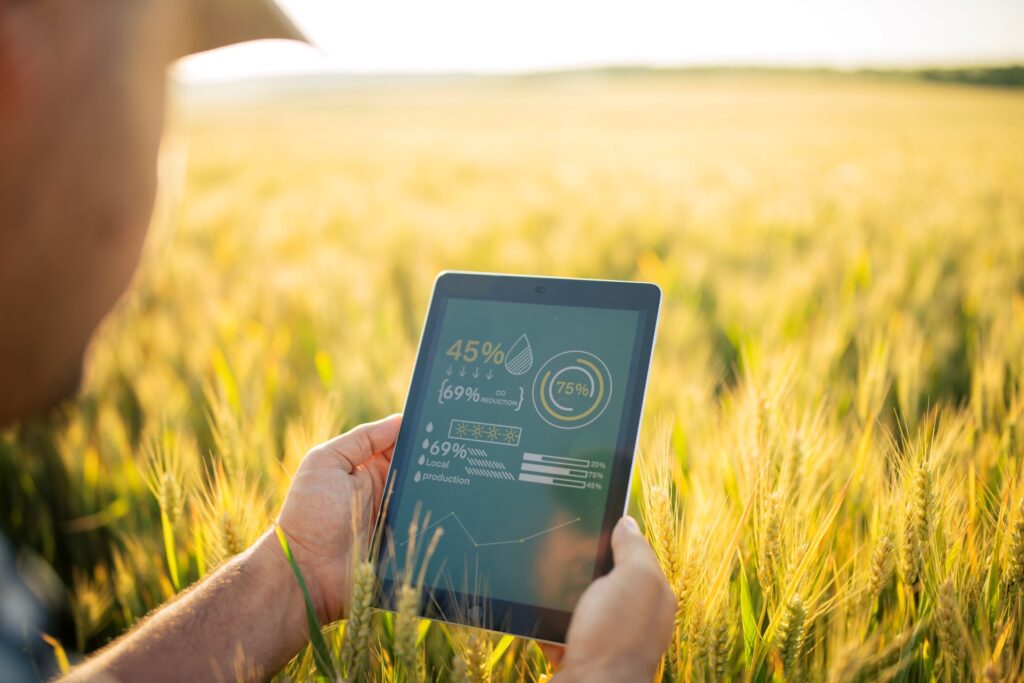
In this blog, Gideon Abegunrin, Data Policy Analyst, explores how CABI is strengthening data stewardship to support more reliable, accessible evidence on crop loss through two of its core projects.
Every year, up to 40% of crops are lost because of pests and diseases, according to the FAO, posing a major threat to food security, trade and livelihoods. Yet the data needed to understand these losses has been fragmented, inconsistent and difficult to access. This applies across across countries, gender, and farming systems.
Producing robust global estimates of crop loss has therefore long been a challenge. This is due to inconsistent metrics, standards, and classification systems across datasets. This highlights the need for more than data collection alone, and points to how data is managed, shared and used across its lifecycle.
Data stewardship addresses this challenge by ensuring data is well organized, documented and shared in a way that keeps it reliable, secure and usable for decision-making.
At CABI, two complementary approaches advance this work. In particular, the ‘Global Burden of Crop Loss’ (GBCL) project draws on existing datasets and works with experts and partners across regions to generate more consistent, data-driven estimates of crop loss. In parallel, the ‘Enabling FAIR data sharing and responsible data use’ (EDA) project is strengthening how data is managed and shared, helping ensure it can be effectively reused. Together, these projects are linking better data with better stewardship.
FAIR from the start
To support this, the team developed a project-specific data management and access plan (DMAP). This framework governs how data moves from acquisition through to publication. It ensures data is managed securely and consistently. It also safeguards alignment with FAIR (findable, accessible, interoperable and reusable) principles as part of a structured approach to data stewardship.
Specifically, the GBCL team adapted an existing DMAP template from the FAIR Process Framework. This was developed through the EDA project. The framework offers practical six‑step method that teams can incorporate into grant‑making and project delivery. The DMAP helps identify risks early on and embeds FAIR principles from the outset.
The template covers the core stages of the data life cycle. It spans acquisition and processing to sharing and publication. Each section maps to a distinct stage of the data lifecycle, which ensures a clear and well-governed approach throughout.
Data stewardship through collaboration
A key strength of this approach came from co-developing the DMAP between the EDA and GBCL teams. This embedded data stewardship practices directly into project workflows. The team developed each section through detailed mapping to track how data moves through the project. This includes who collects it, in what format, under what conditions, and with what constraints.
As a result, the DMAP reflects operational reality rather than an idealized model. It captures both the rigour of data handling across the lifecycle and the strategic objectives shaping its use. Moreover, the team designed the DMAP as a living document. It is revisited and refined as a project evolves, making it a practical tool rather than a compliance exercise.
The process produced other data documentation, including SOPs (Standard Operating Procedures), metadata templates and a shared glossary of terms. This supports consistent and standards-aligned data stewardship.
Addressing practical challenges was equally important. For example, uncertainty around which data licenses to use initially slowed sharing and publication, particularly on how a number of datasets produced by third parties can be reused. As a result, working closely with the modelling team helped clarify these issues and build confidence in how data could be used.
Implementing FAIR data using CKAN
While FAIR principles are widely understood, implementing them consistently remained a challenge. To address this, CABI’s data specialists developed practical guidance and onboarding support to help GBCL researchers prepare and publish datasets.
GBCL uses CKAN (Comprehensive Knowledge Archive Network) as its data repository. CKAN is an open-source data management system. It provides a structured environment for publishing, documenting and accessing datasets. The specialists supported researchers through hands-on onboarding sessions, including demonstrations of the CKAN workflow. These sessions guided teams through the full publication process, from metadata entry to dataset release.
The system assigns DOIs (digital object identifiers) to datasets published through CKAN and supported by rich metadata and documentation. This ensures they are not only available, but also findable, accessible and reusable in line with FAIR principles.
From collaboration to practical impact
This work shows that effective data stewardship comes not from frameworks alone, but through close collaboration between projects, teams and disciplines. By jointly developing a living DMAP, resolving licensing challenges, and supporting data publication, EDA and GBCL moved FAIR implementation from principle to practice.
The result is a framework to publish a set of well-described, accessible data products that can support decision-making on crop loss. As GBCL’s work scales, these foundations provide a model for how FAIR data principles can be embedded into real-world programmes.
Additional information
Featured image credit: ArtistGNDphotography/iStock via Getty Images
Projects:
‘Global Burden of Crop Loss’
‘Enabling FAIR data sharing and responsible data use’
Related blogs:
Strengthening FAIR data systems for digital agriculture
Partnering to improve crop loss data for Odisha’s rice farmers
CABI workshop explores gendered impact of maize crop loss in Kenya
1 Comment
Leave a Reply
Related News & Blogs
Crop loss: What do maize losses really mean for women farmers?
Crop loss can have devastating impacts on rural communities. The Global Burden of Crop Loss recently published a study on maize crop losses in Kenya to explore their age- and gender-differentiated impacts on maize farming communities across different agroecological zones.
22 September 2026

Thanks for the article. Addressing data fragmentation is essential for producing reliable global estimates.