
Vietnam is taking an important step towards greener, safer and more sustainable agriculture.
Working in partnership with CABI and experts from the Shandong Academy of Agricultural Sciences (SAAS), a new collaboration allows Vietnam to advance biocontrol research, build national capacity and support farmers in adopting environmentally responsible pest management practices.
Protecting Vietnam’s agricultural future
Agriculture is integral to Vietnam’s economy. In 2024, the sector achieved a record USD 62.4 billion in exports. Rice alone accounted for 9 million tonnes, generating over USD 5.7 billion. Meanwhile, fruit and vegetable exports climbed to USD 7.2 billion, with durian accounting for USD 3.4 billion. Coffee, pepper and other crops also contributed significantly, highlighting the sector’s role in national revenue and food security.
Despite its success, Vietnamese agriculture faces threats from pest and diseases, challenges that are made worse by the impacts of climate change.
On average, farmers lose 37% of rice yields to pests and diseases. Fall armyworm was detected in 2019 and has spread widely across the country, causing severe damage to maize. Meanwhile, thrips and whiteflies continue to threaten vegetables. Poor management practices amplify these losses, aggravating an already difficult situation.
Supporting farmers to implement sustainable pest management is therefore critical in protecting the future of Vietnam’s agricultural sector.
Partnerships for a sustainable future
Vietnam is a valued Member Country of CABI, joining officially in 1992 – a membership which can be seen as an international extension of Member Countries’ capabilities. During this strong partnership, CABI and the Vietnam Academy of Agricultural Sciences (VAAS) and other organizations have helped the country to mitigate pests and diseases, meet sanitary and phytosanitary requirements and engage with key agricultural value chains.
For example, as part of the Safer Spices: Boosting Food Safety and Market Access for the Peppercorn Value Chain in South East Asia project, CABI helped Vietnam take the lead in developing a Code of Practice (CoP) for peppercorn production. The CoP yielded positive results not only for Vietnam, with better pest management practices and yield increases, but also south-south collaboration with Cambodia and Laos.
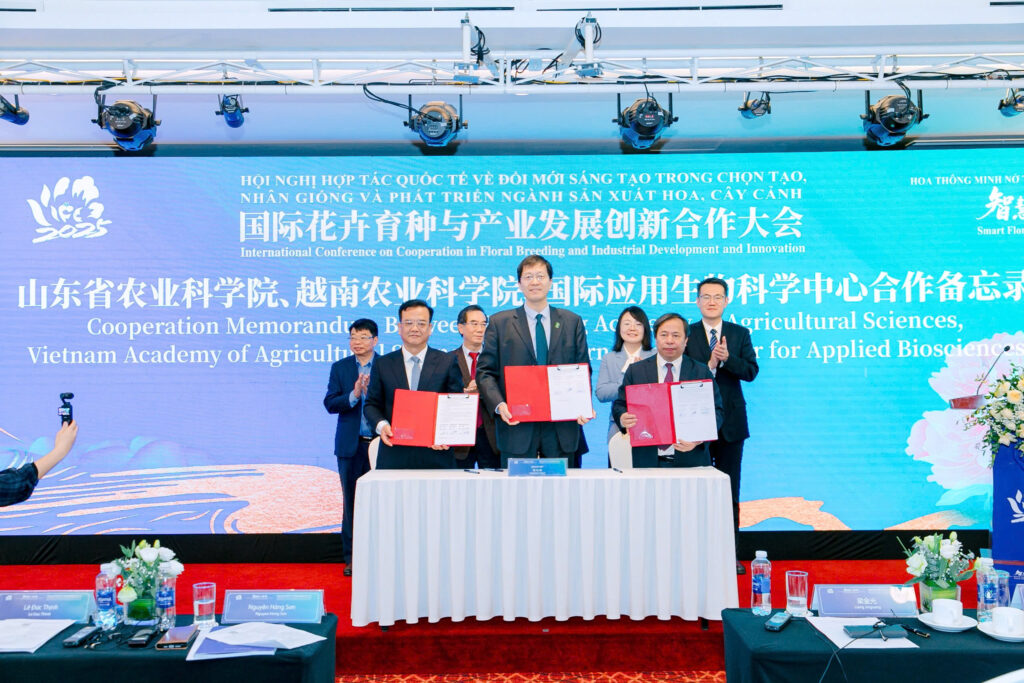
This new collaboration, facilitated by CABI, builds on existing relations and includes a Memorandum of Understanding (MoU) between VAAS, CABI and SAAS. The agreement formalizes their partnership and sets a framework for joint research, knowledge sharing and a new Centre of Excellence for Biological Control.
As a result, it demonstrates how scientific expertise, regional cooperation and practical application can address agricultural challenges. By reducing pesticide use, improving crop health and protecting biodiversity, VAAS, SAAS and CABI are building a sustainable and climate-resilient food system.
Dr Feng Zhang, CABI Regional Director for East and Southeast Asia, said, “This tripartite collaboration brings practical, science-based solutions to farmers, helping them grow safer and high-value agricultural produce while protecting the environment.”
Increasing Vietnam’s biocontrol knowledge
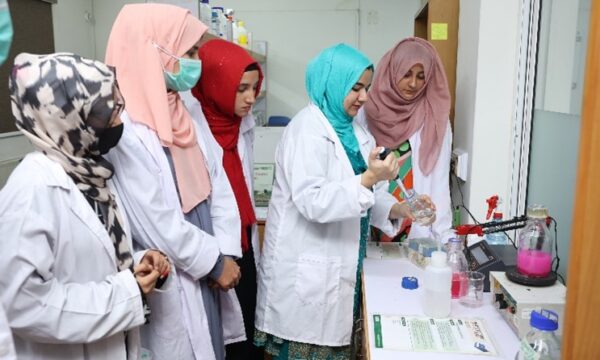
Taking advantage of networking opportunities, knowledge exchange and technology transfer – key benefits of being a CABI Member Country – the signing of the MoU took place during a high-level visit which included a biological control seminar at the Plant Protection Research Institute in Hanoi. SAAS and CABI experts demonstrated mass-rearing techniques for natural enemies like Trichogramma, Orius, and predatory mites. The seminar included hands-on sessions, interactive discussions and practical demonstrations.
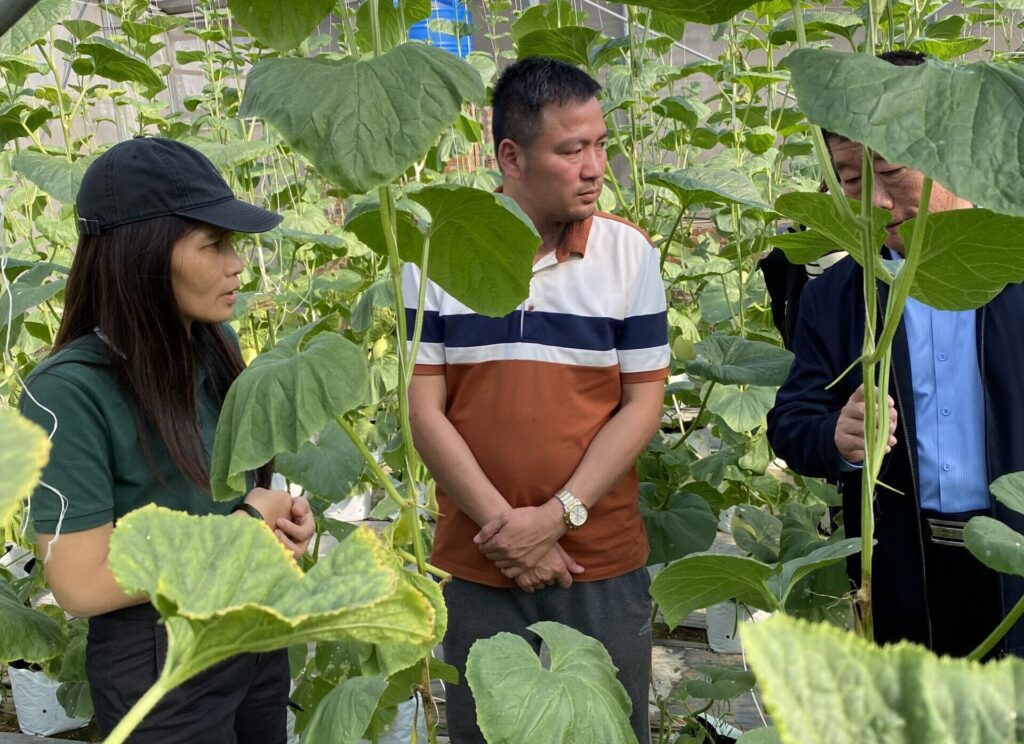
Following the seminar, the team visited a melon cooperative farm. They observed pest challenges firsthand and discussed biocontrol solutions with farmers. These visits highlighted the importance of adapting techniques to local conditions and helping farmers apply Integrated Pest Management effectively, helping Vietnam to advance biocontrol knowledge.
“Working closely with Vietnamese colleagues allowed us to share practical techniques and adapt them to local farming conditions,” said Prof Li Zheng, biocontrol expert of SAAS. “We are excited to see these solutions implemented to reduce pesticide use and improve crop productivity.”
Conventional pesticide use increases resistance and environmental risks. Biological control provides a nature-based solution, reducing chemical inputs, protecting biodiversity and improving yields. Through this exchange, CABI helps Vietnam scale these solutions regionally and support climate-smart farming practices.
Establishing a Centre of Excellence
A key outcome of the new collaboration is a Centre of Excellence for Biological Control. The centre will focus on research, training and innovation. It will improve mass-rearing techniques for natural enemies, develop standard operating procedures and establish field demonstration plots.
Digital tools and knowledge platforms will complement on-the-ground efforts, helping researchers and extension officers access training resources and guidance. By combining training, demonstrations and technology transfer from China, the centre will enhance Vietnam’s research capacity and support sustainable crop production, contributing significantly to Vietnam advancing biocontrol knowledge.
Capacity building and practical impact
Capacity building for farmers and technical staff will also be enhanced. Training programmes and exchange visits with China will strengthen skills and knowledge transfer. In synergy with other CABI-led programmes such as PlantwisePlus, farmers and extension officers will be able to access CABI’s Bioprotection Portal, PlantwisePlus Knowledge Bank, PlantwisePlus Digital Tools, and CABI Academy Courses covering crop pest diagnosis, pest management, and sustainable soil practices.
Researchers will conduct field demonstrations and develop practical guidelines, supporting broader adoption of biocontrol practices. Digital platforms will ensure knowledge reaches farmers and extension officers nationwide.
A partnership for a greener future
Dr Nguyen Hong Son, President of VAAS, highlighted that the collaboration will enhance research capacities, technology development and practical implementation of biocontrol solutions nationwide.
Mr Jinguang Liang, Secretory of SAAS, stressed the importance of the collaboration to build win-win partnerships and the promotion of south-south co-operation and technology transfer.
Through this joint effort, VAAS, SAAS and CABI are taking concrete steps toward a future where innovation and collaboration drive sustainable agriculture in Vietnam and the wider region, supporting Vietnam to advance biocontrol.
Additional information
Main image: Group photo during the Memorandum of Understanding (MoU) between representatives from VAAS, SAAS and CABI. An MoU which supports Vietnam to advance biocontrol (Credit: VAAS)
Relevant stories
CIRAD and CABI join forces to strengthen sustainable agriculture in Southeast Asia
Safer Spices: Improving quality and market access for peppercorn in Vietnam, Lao PDR, and Cambodia
Related News & Blogs
Regional knowledge exchange advances pesticide risk reduction in Ethiopia
Across Ethiopia, smallholder farmers continue to face growing pressure from pests that threaten horticulture production, incomes, and food security. In response, many rely heavily on chemical pesticides, sometimes as the only available option. How do w…
5 May 2026