
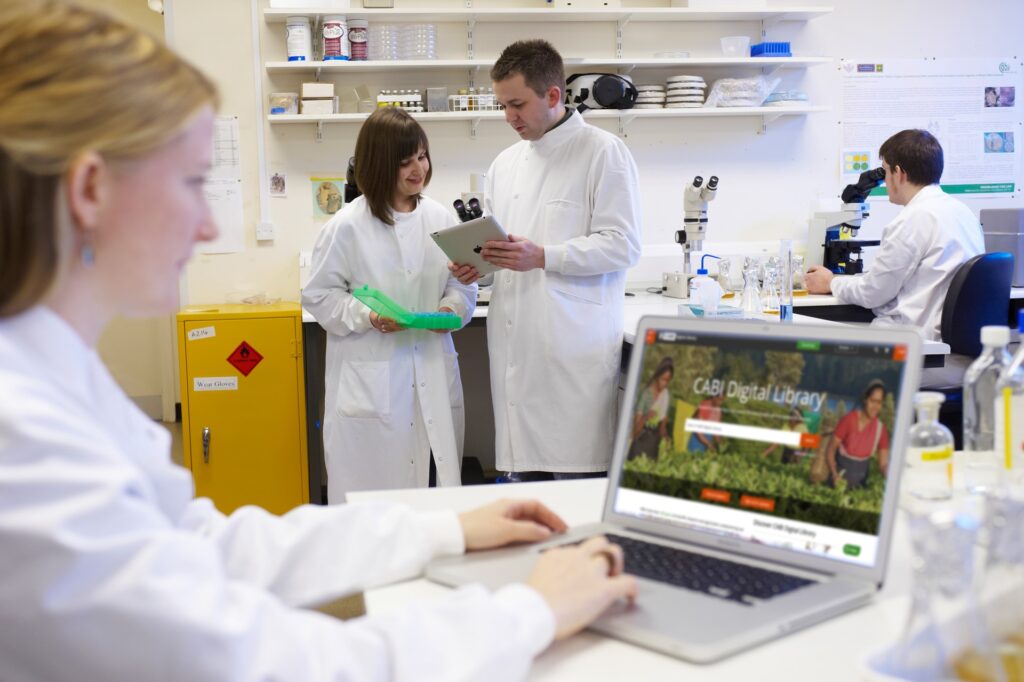
In 2025, CABI supported 26.4 million students, researchers, and practitioners through the CABI Digital Library, which is now available to over 13,600 institutions. We advanced our work in evidence for policy, providing decision-makers with trusted science-based knowledge content, launched the sustainable development tool, SDGenie, and strengthened our partnerships.
Supporting researchers, practitioners, and policymakers with trusted knowledge and tools
For researchers, practitioners, and policymakers, access to reliable information shapes stronger research, better decisions, and more effective action. Together, these efforts are critical for helping to solve some of the biggest global challenges that we face today, from climate change to hunger and poverty. In 2025, CABI continued expanding the knowledge resources and tools designed to support decision-making for impact and change.
Through CABI Digital Library, we supported 26.4 million students, researchers, and practitioners worldwide, providing them with trusted scientific knowledge spanning subjects across the life sciences. Our unique content platform houses all CABI’s content in one easy-to-access location and is now available in 13,600 institutions.
It generated 56 million page views over the year. Our publishing team produced 3,400 new book chapters, journal articles, and other scholarly works, while our databases expanded with the addition of 600,000 new records. This means broader access to the latest data, insights, and studies needed to inform research, practice and policy.

Strengthening evidence for policy
Policymakers and people working on complex global challenges rely on evidence-based information. Supporting research that makes this possible is one of CABI’s primary goals. Last year, we advanced our objectives by publishing four milestone evidence syntheses, including the One Health Horizon Scan. We also launched a Skills Framework for Evidence Synthesis and an associated Primer on Evidence Synthesis. Evidence synthesis is the systematic process of collecting, evaluating, and combining findings from multiple studies to produce clear, reliable insights. It is a process that brings together knowledge to help decision-makers understand where gaps remain and, therefore, what next actions or investments are needed.
In addition, in 2025, the CABI-led Global Burden of Crop Loss project made significant progress developing data-driven models that draw on more than one million crop loss observations around the world. These models provide concrete country-level and global estimates of losses for maize, rice, and wheat. They give critical insights into the associated economic impacts of crop loss, as well as clearer estimates of food losses, to help evidence-based decision-making to address food security.
As ever, our mission is to equip policymakers, practitioners, and researchers with the tools they need to address global challenges with confidence.
“Some of the most meaningful development actions we take are based on data and evidence, as they help us understand when and where our efforts deliver the most benefit.” – Duncan Barker, FCDO
Helping researchers connect their work to the SDGs
Researchers are increasingly aware of the need to connect their work to the UN’s Sustainable Development Goals (SDGs), addressing challenges such as climate change and poverty. In 2025, we launched SDGenie, a new prototype tool that explores how text, such as research abstracts, can be matched to specific targets set out in the SDGs. This free resource now offers researchers a new way to confidently identify the 169 detailed SDG targets – rather than the broader 19 goals – to make their work even more relevant and specific to sustainable development.
Expanding partnerships for global knowledge sharing
Knowledge sharing is critical for solving the world’s biggest challenges, making collaborations and partnerships an essential part of our work. Last year, we partnered with the International Society of Horticultural Science, enabling the European Journal of Horticultural Science to join our growing portfolio of journals, extending its reach within the research community.
We also embarked on a collaboration with 1000 Landscapes for 1 Billion People, to create a new journal in 2026, expanding our work in Integrated Landscape Management. In addition, we established publishing partnerships with AgriWeb and Nuffield Farming for cases, and with the Entomological Society of India for books, strengthening global knowledge sharing in agriculture and the environment.
Supporting better decisions with trusted knowledge
For researchers, practitioners, and policymakers, access to reliable knowledge is the foundation of decision-making. Evidence that underpins better study enables researchers to develop new ideas. Practitioners can apply proven solutions in areas ranging from animal welfare to climate adaptation. Policymakers are empowered to design more effective data-driven strategies. Expanding access to science-based knowledge and tools lays out the foundation for lasting change.
In 2025, we strengthened CABI’s ability to deliver trusted knowledge to customers and stakeholders for better decision support. In this way, CABI can play its part in delivering measurable impact to communities worldwide.
Related content
Related News & Blogs
Equipping decision-makers with evidence to tackle global crop loss
Every year, up 40% of crops are lost globally before they are even harvested. This loss, estimated by the Food and Agriculture Organization (FAO), undermines food security, farmer livelihoods and economic stability. However, the problem is poorly under…
21 May 2025